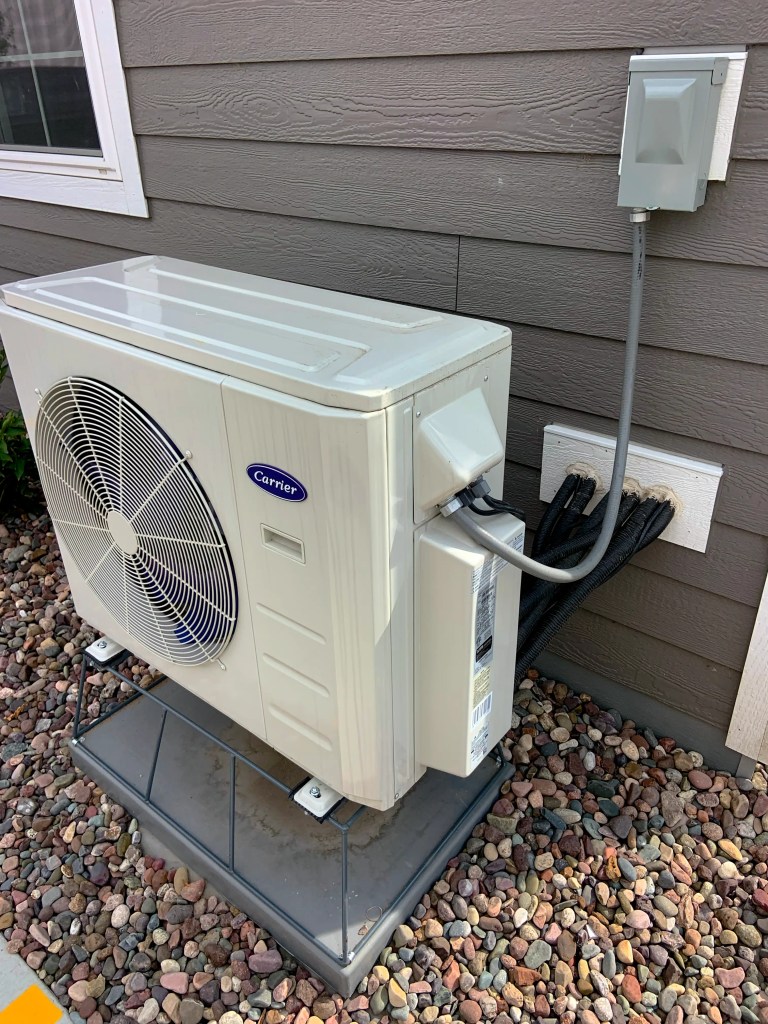
• So, what if you’re not quite ready to transition to a heat pump yet? If your gas boiler is still relatively new, functioning well, and you can’t justify removing something that’s working perfectly fine – not to mention the potential need for radiator or water cylinder upgrades – it might seem premature to make the switch. While moving to a heat pump would reduce emissions, you could actually increase your carbon footprint by discarding perfectly serviceable components of your heating system.

    There are, however, other steps you can take to lower your gas consumption and thereby reduce your carbon emissions. An added benefit is the potential for lower energy bills. Firstly, it’s important to understand your usage patterns. With many of us now having smart meters at home that generate half-hourly readings, it’s easy to track your consumption and see when you’re using the most energy. You could even export this data into a spreadsheet and analyse how your usage varies with local weather conditions. There are websites that provide degree day information for your area, and a simple scatter plot comparing consumption against degree days can be a great starting point.

    Next, consider lowering the temperature in unused or rarely used rooms. While experts like Heat Geek advise against completely turning off heating in certain rooms, reducing the temperature in spaces you use infrequently can help. This is especially beneficial if you have an older, non-condensing boiler or one that doesn’t allow you to reduce the flow temperature. Products like Tado are worth investing in, as they provide convenient control via smartphone apps. Lowering the heat in unused rooms also allows radiators in occupied spaces to heat up more quickly, improving comfort. However, be mindful that if you lower the temperature in all but one room, the return temperature of your radiators might not be low enough for your boiler to condense effectively and recover energy from waste gas. Additionally, balancing your radiators ensures heat is distributed evenly across your home, preventing a single room that takes too long to warm up from causing your boiler to run unnecessarily longer.

    Every home is unique in how it heats up. I take a cold snap as an opportunity to test new strategies for heating my house. For example, by analysing Tado data on individual room temperatures, heating times, and overlapping this with smart meter gas consumption data, I discovered that a large open-plan kitchen, living, and dining area takes a long time to heat up. I experimented with infrared heating in that space to see if it could maintain thermal comfort at a similar cost to gas while producing lower emissions. By using steady-state heating to maintain a slightly lower temperature and boosting it when needed, we managed to reduce carbon emissions while keeping heating costs stable. Analysing smart meter data in this way can help you understand gas consumption for individual rooms. Another tactic we tried was ensuring the boiler didn’t cycle too frequently. By adjusting the heating schedules for different rooms, we were able to keep the boiler running consistently rather than stopping and restarting, which improves efficiency. Ultimately, understanding your heating needs will not only help you stay warm but also allow you to better analyse quotes and designs for heat pumps if you decide to switch in the future. Stay warm, and remember, all this analysis will help you heat your home more intelligently!

  • When considering heat pumps, one of the main factors to bear in mind is the system’s running costs. Here, the design of the heat pump system plays a crucial role. A poorly designed system, especially one that’s significantly oversized, can cause frequent cycling. Cycling, or short cycling, is when the heat pump repeatedly turns on and off before it’s had enough time to thoroughly heat your home. This typically happens when an oversized heat pump generates more heat than the radiators and underfloor heating can dissipate. If the radiators aren’t upgraded to handle a larger surface area, the problem of heat dissipation only worsens.

    So why is it a problem if the heat pump switches on and off frequently? You might wonder, as gas boilers do this all the time. However, heat pumps are most efficient when heating steadily and gradually. The initial start-up phase is less efficient since the pump has to ramp up to generate heat, but once it reaches a stable flow, it ticks along efficiently. Excessive short cycling, where the pump runs briefly, shuts off, and then has to ramp up heavily again, disrupts this efficiency and can lead to higher running costs.

    Another consideration is whether you have a time-of-use electricity tariff, perhaps because you already have an electric vehicle (EV) or have chosen a tariff designed for heat pumps, offering cheaper electricity at specific times. Some evidence suggests you might be able to preheat your home slightly during these off-peak times, letting the building materials store some of that heat so the pump can run less during peak hours. Similarly, you could use the off-peak period to heat your water, storing it for later use. If you don’t already have a time-of-use tariff, check with your energy provider to see what options are available. However, not all tariffs will suit your lifestyle: if, for instance, you’re up at 5 am and out by 6 am, preheating during the cheap period wouldn’t be effective. Choose a tariff that fits your routine, and ideally, one that allows for future flexibility.

    Finally, consider whether your home has rooms that aren’t frequently used. Perhaps the kids have moved out, leaving a few bedrooms seldom used. In this case, check with your installer to determine the best heat pump settings. Should you keep all rooms at the same temperature, or is it more efficient to lower the temperature in unused rooms? While some experts advise against switching off radiators in individual rooms, you might benefit from setting a lower temperature in certain spaces so the heat pump operates more efficiently at a steady level. If you’re not comfortable adjusting these settings often, especially for infrequent guests, you might consider keeping a few oil-filled or portable heaters on hand instead.

    In general, a well-designed heat pump system should help you reduce heating costs, especially if you’re currently using an older, non-condensing gas boiler (a topic we’ll cover in a future post). For now, stay warm and heat smartly!

    ,
  • So, if you’ve decided to go down the heat pump route, what are the key considerations?

    Firstly, the most crucial factor influencing your decision is the heat pump’s design, a complex topic with many aspects to consider. When you engage an installer, their first priority will be to assess the heat loss of your property. In simple terms, heat loss refers to the amount of heat that escapes through your property’s walls, doors, windows, floors, and roof. This process is complex and could fill a series of blog posts in itself. For now, though, the installer will calculate the heat loss of your property using a standard outside temperature set for your location by MCS (the Microgeneration Certification Scheme), designed to heat your home to 21 degrees Celsius. This target temperature may vary slightly based on the type of room, so the installer will calculate heat loss for each room individually, then total it for the entire property.

    Once this heat loss is established, you’ll need a heat pump that can at least match this output. Note that this figure refers to the heat output rather than electricity consumption, as heat pumps typically produce more heat than the energy they consume—often achieving efficiencies of 300% or more, depending on their coefficient of performance (COP). The COP value is key to understanding your running costs, so it’s definitely worth a deeper dive in a future post. There are also some excellent YouTube videos on this topic; if you haven’t yet, check out *Heat Geek* or *Urban Plumbers* for more insights.

    Pay careful attention to any assumptions your installer makes when calculating heat loss, as even small mistakes can skew the result, leading to an oversized or undersized heat pump. For example, one installer we received a quote from had overestimated our heat loss because they assumed our house was built around 1982, resulting in a much higher estimate of around 80 W/m²—similar to a Victorian property. However, our home was actually built after 2010 and includes double glazing, good loft insulation, cavity wall insulation, and underfloor insulation. *Heat Geek* suggests a heat loss of around 20–40 W/m² for similar properties, meaning this installer had essentially doubled our heat loss and recommended a substantial 14 kW heat pump. This could have led to both higher initial and running costs, as an oversized heat pump would cycle on and off excessively, reducing the COP and driving up operating expenses. Be sure to review every detail of the design your installer provides, and don’t hesitate to ask questions to ensure you’re comfortable with their approach.

    Unlike a gas boiler, a heat pump circulates hot water at a much lower temperature through your heat emitters (radiators or underfloor heating). As a result, you may need to upgrade your radiators to achieve sufficient heat output, as a lower flow temperature means you’ll require larger surface areas for heat emission. In our case, all the radiator sizing was incorrect, as the installer had based their calculations on an inflated heat loss for each room due to incorrect assumptions.

    More on heat pumps design in the next blog post. Till then, keep warm but heat smart!

    ,
  • To kick off the blog, I’ll begin by discussing the need to decarbonise heating in the UK. In future posts, I’ll cover the different options available, the pros and cons of heat pumps, alternatives to heat pumps, and various considerations for decarbonising heating in general.

    One might ask, why bother with electrifying home heating? After all, gas central heating has been a well-established part of our homes in the UK for quite some time. While we rarely experience the extreme cold seen in places like Canada, parts of the US, and Scandinavia—though some areas in Scotland can get particularly chilly—the average UK home still requires heating for at least four or five months of the year. Ofgem estimates indicate that UK homes consume about 12,000 kWh of natural gas annually for heating and hot water. Around three-quarters of UK homes rely on natural gas for heating—roughly 21 million homes—and natural gas emits approximately 200 grams of CO2 per kWh consumed. This translates to around 50 billion kilograms of CO2 each year from domestic heating alone. With the UK’s per capita emissions averaging around 5,000 kilograms of CO2, domestic heating accounts for about 20% of our individual emissions. Therefore, if we can find a way to heat our homes more efficiently, we could reduce roughly a fifth of our emissions and make a significant contribution towards combating climate change.

    It’s not just about emissions; there are many other factors to consider. The cost-of-living crisis, driven by spikes in global oil and gas prices, has highlighted the importance of energy independence. Additionally, UK homes are built with an extensive network of pipes embedded within walls and floors to circulate heat via radiators and underfloor heating. Any decarbonisation efforts must be designed to minimise disruption, as it wouldn’t be feasible to tear out walls and floors to start from scratch. Aesthetic considerations are also crucial—homes need to retain their pleasing appearance, and most existing homes already have some form of heating. This means that, except in new builds or extensive renovations, new heating installations will generally be replacements for existing systems. As such, installation costs and the added value to our homes need to be carefully evaluated. Moreover, when replacing millions of existing systems, we cannot ignore the carbon footprint involved in manufacturing new heating systems, as it adds to the emissions we’re aiming to reduce through decarbonisation.

    All in all, there are many aspects to consider, which is why this topic remains so widely discussed and frequently covered in the media.

    ,

I’m Chandy

Welcome to Heatopia, my geeky attempt to talk about renewable heating and energy. I am not an expert, but just enthusiastic about saving our planet.

Let’s connect